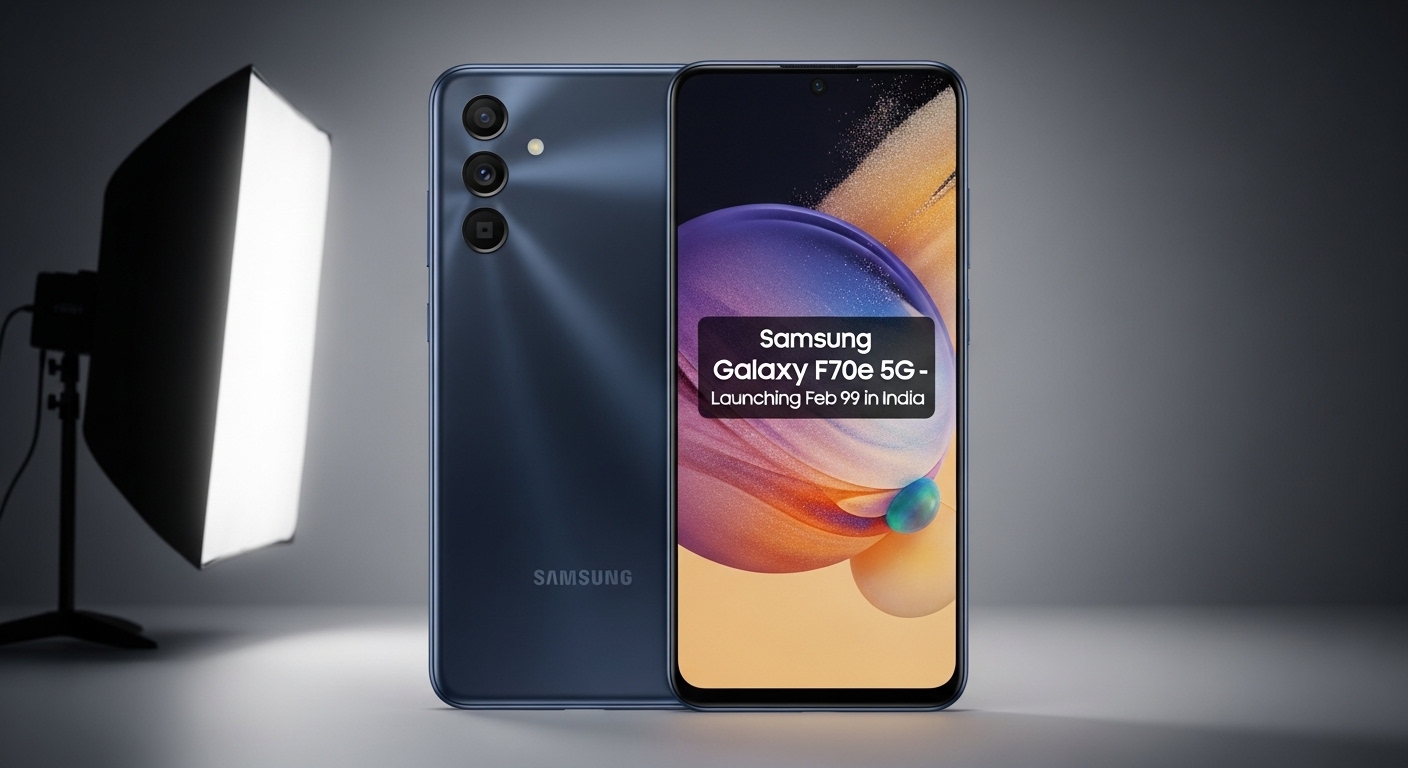
Samsung is gearing up for another India-specific smartphone launch, and this time it’s the Galaxy F70e 5G hitting stores on February 9th. If you’re scratching your head wondering what the “F” series is all about, you’re not alone—Samsung’s lineup can feel like alphabet soup sometimes. But the F-series has carved out a specific niche in India’s competitive smartphone market, and the F70e looks set to continue that tradition.
Let me break down what we know so far, what to expect, and whether this phone is worth your attention when it drops next week.
Understanding Samsung’s F-Series Strategy
First, let’s talk about what the F-series actually represents. Samsung launched the Galaxy F lineup exclusively for India back in 2020, positioning it as a budget-to-mid-range series focused on battery life and performance at aggressive price points. These phones are sold primarily through Flipkart, Samsung’s e-commerce partner in India.
The F-series sits somewhere between Samsung’s M-series (budget workhorses) and A-series (mid-range all-rounders). Think of it as Samsung’s answer to brands like Realme, Redmi, and POCO that have dominated India’s online smartphone market with spec-heavy phones at killer prices.
The “e” suffix in F70e likely indicates this is a slightly stripped-down or more affordable variant, similar to how Samsung uses “e” in other models. It’s a smart strategy—offer the core features people want while cutting costs on less essential elements to hit an attractive price point.
Expected Specifications (Based on Leaks and Teasers)
While Samsung hasn’t officially confirmed all the specs, reliable leaks and teaser campaigns give us a pretty solid picture of what the F70e 5G will offer:
Display: Expect a 6.6 to 6.7-inch FHD+ Super AMOLED display with a 120Hz refresh rate. Samsung typically delivers excellent displays even on budget phones, and AMOLED at this price point is a significant advantage over competitors using LCD panels. The 120Hz refresh rate ensures smooth scrolling and gaming, which matters for the target audience.
Processor: Most rumors point to either the MediaTek Dimensity 6100+ or possibly the Snapdragon 6 Gen 1. Both are capable 5G chipsets that handle everyday tasks smoothly and offer decent gaming performance for casual players. Don’t expect flagship-level power, but for social media, streaming, and light gaming, these chips are more than adequate.
RAM and Storage: Likely configurations of 6GB/128GB and 8GB/128GB or 256GB. Samsung might also include RAM Plus (virtual RAM) that borrows storage space to expand available RAM, a feature that’s become standard in budget phones. Hopefully, there’s microSD card support for expandable storage—that’s been a staple of F-series phones.
Battery: This is where F-series phones traditionally shine. Expect a massive 6,000 mAh battery, possibly even larger. Samsung knows the Indian market values battery life heavily, and F-series phones routinely pack batteries that last two days with moderate use. Fast charging support will likely be 25W or 33W—not the fastest available, but decent enough.
Cameras: The rear camera setup will probably feature a 50MP main sensor, an 8MP ultra-wide, and a 2MP depth or macro sensor (the kind that exists mostly for spec sheet padding). The 50MP main camera should deliver good photos in daylight with decent low-light performance thanks to software processing. Don’t expect flagship camera quality, but for social media and everyday photography, it’ll be fine.
The front camera will likely be a 13MP or 16MP shooter housed in a centered punch-hole. Adequate for selfies and video calls, nothing spectacular.
Operating System: Android 14 with Samsung’s One UI 6.0 on top. Samsung has been good about launching phones with recent Android versions, and One UI has matured into a clean, feature-rich interface. Software support is crucial—Samsung typically promises two years of OS updates and four years of security patches for mid-range phones.
5G Connectivity: Full 5G support across multiple bands to ensure compatibility with Indian carriers as 5G networks continue expanding. Wi-Fi 5 or Wi-Fi 6, Bluetooth 5.2, USB Type-C charging port, and a 3.5mm headphone jack (Samsung still includes these on budget phones, thankfully).
Design and Build Quality
Based on teasers, the F70e appears to feature Samsung’s current design language with a flat frame, slightly curved edges, and a camera module that protrudes minimally. The build will likely be plastic back and frame—standard for this price segment—but Samsung’s plastic builds actually feel pretty solid and don’t cheap out like some competitors.
Color options will probably include trendy choices aimed at younger buyers—maybe something like Midnight Blue, Aurora Green, and a neutral Black or Gray option. Samsung knows their F-series audience skews younger and wants phones that look good on social media.
The phone will probably weigh around 200-210 grams thanks to that massive battery. It’s not going to be featherlight, but the weight distribution should make it manageable for daily use.
Pricing: The Critical Factor
Here’s where things get interesting. The F70e needs to be priced aggressively to compete in India’s cutthroat mid-range market. Based on Samsung’s recent F-series launches and competitor pricing, I’m expecting the F70e 5G to land somewhere between ₹18,999 and ₹22,999 depending on the RAM/storage variant.
At ₹18,999 for the 6GB/128GB model, it would be competitive with phones like:
- Realme 12 5G (₹17,999)
- Redmi Note 13 5G (₹18,999)
- POCO X6 5G (₹19,999)
- Motorola Edge 40 Neo (₹21,999)
If Samsung prices it higher than ₹23,000, they’ll struggle. At that price point, buyers start looking at better options from OnePlus, Nothing, or even Samsung’s own A-series phones. Aggressive launch offers, bank discounts, and exchange bonuses will be crucial to driving initial sales.
Launch Day Strategy: Flipkart Exclusivity
The February 9th launch will happen on Flipkart (https://www.flipkart.com), where Samsung’s F-series phones are exclusively sold. Flipkart typically runs aggressive promotional campaigns for Samsung launches, including:
- Exchange offers: Extra value for old phones, sometimes inflated beyond market rates
- Bank discounts: ₹1,000-₹2,000 off with specific credit cards
- No-cost EMI: Making the phone accessible to buyers who can’t pay upfront
- Bundled offers: Discounts on Galaxy Buds or other accessories when purchased together
If you’re planning to buy on launch day, here’s my advice: wait a few hours after the launch goes live. Early batches sometimes have glitches with discount codes or payment processing. Let the initial rush settle, then grab the phone with all applicable offers.
Also, check if your old phone has decent exchange value. Flipkart’s exchange program can be generous during launches, sometimes offering more than the phone’s actual resale value.
Competition: A Tough Neighborhood
Samsung isn’t launching the F70e into a vacuum. The sub-₹25,000 5G segment is absolutely brutal right now. Let’s look at what the F70e is up against:
Realme 12 5G: Strong performer with MediaTek Dimensity 6100+, excellent cameras for the price, and aggressive pricing around ₹18,000.
Redmi Note 13 5G: Xiaomi’s volume king with massive community support, MIUI features, and typically excellent value. Their Note series dominates sales charts month after month.
POCO X6 5G: Snapdragon 7s Gen 2 processor, 120W fast charging, and a performance-focused approach that appeals to gamers and power users. Priced around ₹19,999.
Motorola Edge 40 Neo: Clean Android experience, IP68 water resistance (rare at this price), and Moto’s reputation for reliable performance.
Nothing Phone (2a): The wild card. Nothing has been gaining traction in India with unique design and transparent marketing. Their pricing and features could overlap with the F70e.
What’s Samsung’s advantage? Brand trust, extensive service network, and arguably better software support. Samsung’s One UI gets regular updates, and their service centers are everywhere in India—a huge advantage when something goes wrong.
The disadvantage? Samsung typically can’t match Chinese brands on raw specs-per-rupee. A Realme or POCO at the same price might offer faster charging, more RAM, or better processors.
Target Audience: Who’s This Phone For?
The Galaxy F70e 5G is clearly aimed at:
Young professionals and students who want a reliable 5G phone that lasts all day without needing a charger. The massive battery and decent performance suit people constantly on social media, watching videos, and staying connected.
First-time smartphone upgraders moving from 4G devices to 5G. Samsung’s brand recognition provides confidence for buyers who aren’t tech-savvy but want something dependable.
Budget-conscious buyers prioritizing battery life over everything else. If you’re someone who hates carrying chargers or worrying about battery percentage, that 6,000+ mAh battery is the selling point.
Samsung ecosystem users who already have Galaxy Buds, a Galaxy Watch, or other Samsung devices. The seamless integration across Samsung products adds value if you’re already invested in the ecosystem.
People valuing service network: If you live in smaller towns or cities where Chinese brand service centers are scarce, Samsung’s extensive network is reassuring.
What Could Make or Break This Launch
Software Experience: If Samsung delivers a clean One UI 6.0 experience without excessive bloatware, that’s a win. Too many pre-installed apps or aggressive ads (like some Chinese brands do) would hurt the user experience.
Camera Performance: The 50MP main camera needs to deliver in real-world conditions. If it only looks good on paper but produces mediocre photos, reviews will be harsh.
Thermal Management: Budget phones sometimes overheat during gaming or heavy use. If the F70e can maintain performance without getting uncomfortably hot, that’s important for user satisfaction.
Build Quality: Even though it’s plastic, the phone needs to feel solid. Creaky builds or cheap-feeling materials will drive negative word-of-mouth.
5G Performance: As 5G networks expand across India, the phone needs to deliver stable 5G connectivity. Poor antenna design or compatibility issues would be disastrous.
Should You Buy on Launch Day?
My honest advice: probably not. Here’s why:
Wait for reviews: Tech reviewers will get hands-on units quickly. Give it a week to see real-world performance feedback, camera samples, and battery life tests. Launch day excitement often doesn’t match actual user experience.
Prices might drop: Samsung phones often see discounts within weeks of launch. Unless launch offers are extraordinary, waiting a month could save you ₹2,000-₹3,000.
Competition might respond: Other brands might drop prices or launch competing models. The smartphone market moves fast, and better options could emerge soon.
Stock issues: First batches sometimes have quality control problems. Letting the initial production run sell through means you’re more likely to get a refined unit.
That said, if Samsung nails the pricing at ₹18,999 with excellent launch offers, and reviews are positive, the F70e could be worth grabbing early before offers expire.
The Bigger Picture: Samsung’s India Play
The F70e launch reflects Samsung’s broader strategy in India. They’re not conceding the budget and mid-range segments to Chinese brands. Instead, they’re launching India-specific models through online channels to compete directly on price and specs.
According to IDC India (https://www.idc.com/ap/smartphone-tracker), Samsung has been losing market share in India’s smartphone market to aggressive competitors. The F-series is their counterpunch—value-focused phones that leverage Samsung’s brand strength while matching competitor specs.
Whether this strategy works long-term depends on execution. Samsung can’t just rely on brand name—they need to deliver genuine value, competitive pricing, and excellent after-sales support to win back buyers who’ve switched to Realme, Redmi, or POCO.
The F70e 5G launching on February 9th is Samsung’s latest attempt to prove they can compete aggressively in India’s toughest smartphone segment. Whether they succeed will become clear in the weeks following launch when real users vote with their wallets.
Mark your calendar, but keep your expectations realistic and your wallet patient until reviews roll in.