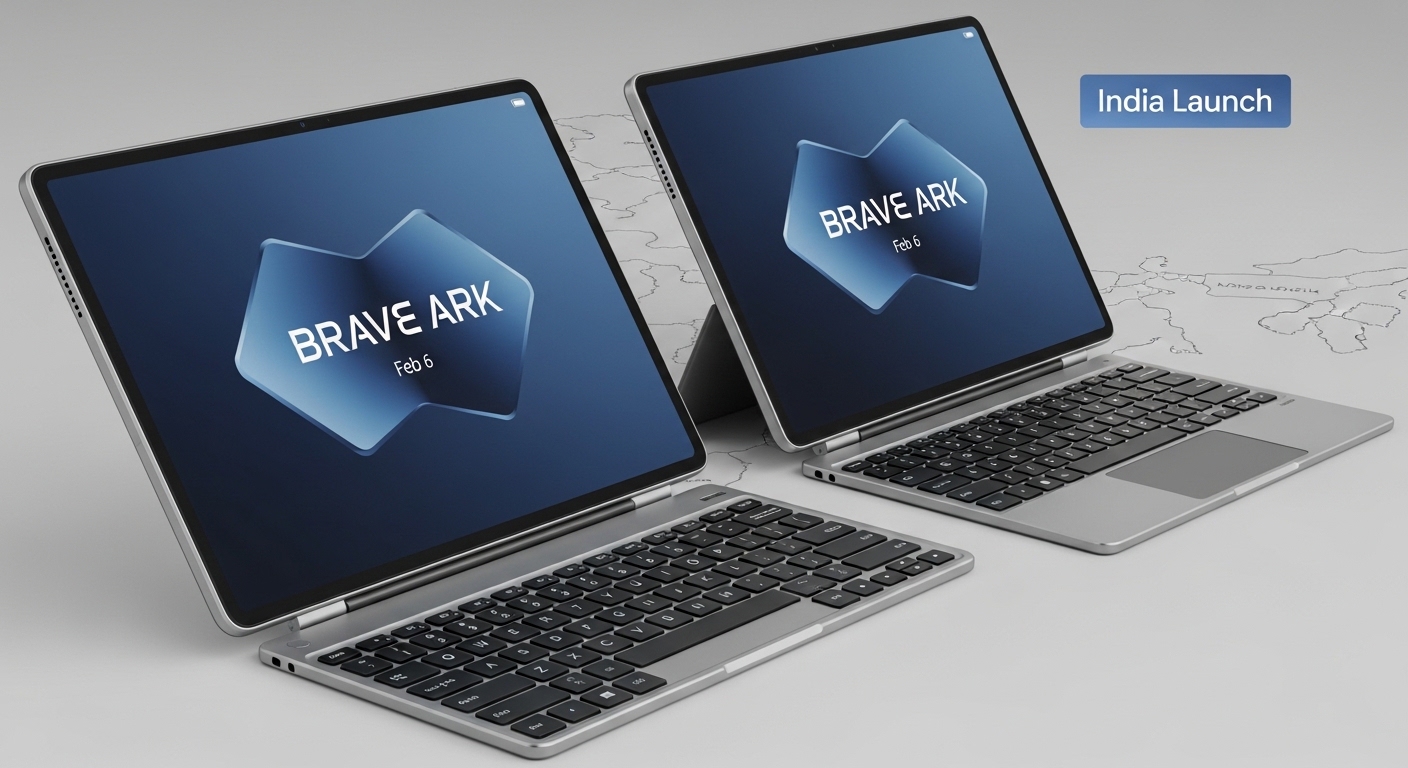
Mark your calendars, tech enthusiasts—February 6 is shaping up to be an interesting day for India’s gadget market. Brave, a relatively new player in the Indian consumer electronics space, is launching something they’re calling the Ark, a 2-in-1 Android device that’s promising to blur the lines between tablet and laptop.
Now, I’ll be honest—when I first heard about this, my skepticism kicked in. We’ve seen countless companies try to crack the 2-in-1 formula, and most end up creating devices that are mediocre tablets and terrible laptops, or vice versa. But Brave seems to be taking a different approach, and there’s enough buzz around the Ark to suggest they might actually have something worth paying attention to.
What Exactly Is the Brave Ark?
From what Brave has teased so far, the Ark is an Android-powered tablet with a detachable keyboard that transforms it into a laptop-style device. Think Microsoft Surface, but running Android instead of Windows. The concept isn’t entirely new—Samsung has been doing this with their Galaxy Tab S series for years—but Brave is targeting a different market segment with aggressive pricing.
The device appears to sport a 10.5-inch or 11-inch display (exact specs are still under wraps), comes with a magnetic keyboard cover that includes a trackpad, and runs on what’s likely a mid-range processor—probably something from MediaTek’s Dimensity series or possibly a Qualcomm Snapdragon 7-series chip.
What makes this interesting for the Indian market is Brave’s positioning. They’re not trying to compete with premium tablets like the iPad or Galaxy Tab S9. Instead, they’re going after the massive market of students, first-time tablet buyers, and people who want a portable device for productivity without spending flagship money.
Brave’s Track Record in India
For those unfamiliar, Brave entered the Indian market about two years ago with budget smartphones and accessories. They haven’t exactly set the market on fire, but they’ve built a reputation for offering decent specs at competitive prices. Their phones aren’t going to win any awards for innovation, but they work reliably and don’t break the bank.
The company seems to understand the Indian market’s price sensitivity. According to Counterpoint Research (https://www.counterpointresearch.com), India is one of the fastest-growing tablet markets globally, but most of the growth is in the budget and mid-range segments. Premium tablets sell, sure, but the real volume is in devices under ₹30,000.
Brave is clearly positioning the Ark to capture exactly that segment—buyers who want tablet versatility with some laptop functionality but aren’t ready to drop ₹60,000+ on an iPad with Magic Keyboard or a Galaxy Tab with keyboard cover.
Expected Specifications (Based on Teasers and Leaks)
While Brave hasn’t officially confirmed all the specs, industry leaks and teaser images give us a pretty good idea of what to expect:
Display: Likely a 10.5 to 11-inch IPS LCD with 2K resolution. Don’t expect OLED at this price point, but a good IPS panel can still deliver crisp text and decent colors for productivity work.
Processor: Probably a MediaTek Dimensity 7200 or Snapdragon 7 Gen 1. These are solid mid-range chips that handle everyday tasks smoothly and can even manage light gaming. They won’t compete with flagship processors, but for document editing, web browsing, and media consumption, they’re more than adequate.
RAM and Storage: Expectations are for 6GB or 8GB of RAM with 128GB or 256GB storage options. Hopefully, there’s microSD expansion, which is crucial for a device targeting students and content creators who need space for files and media.
Battery: A tablet of this size should pack at least a 7,000-8,000 mAh battery. Anything less would be disappointing. With moderate use, that should easily deliver 8-10 hours of screen time.
Operating System: Android 13 or possibly Android 14 if Brave wants to make a splash. The real question is software support—will they commit to timely updates and security patches? That’s where budget brands often drop the ball.
Keyboard and Accessories: The bundled keyboard is the big unknown. Is it included in the base price or sold separately? How good is the typing experience? Does the trackpad actually work well with Android’s desktop mode? These details matter enormously for a 2-in-1 device.
Connectivity: Expect Wi-Fi 6, Bluetooth 5.2, and possibly a 4G LTE variant for people who want cellular connectivity on the go. A USB-C port is a given, hopefully with OTG support and video output capability.
The Android Desktop Experience Challenge
Here’s where things get tricky. Android has come a long way in terms of desktop functionality, but it’s still not Windows or even iPadOS when it comes to productivity. Google’s desktop mode on Android improves with each version, but app support is inconsistent.
Samsung has done impressive work with DeX, their desktop interface that works brilliantly on Galaxy Tabs. Brave will need something similar to make the Ark genuinely useful as a laptop replacement. If they’re just relying on stock Android with a keyboard attached, the experience might feel clunky.
The good news is that for the target market—students taking notes, people doing basic office work, content consumption—Android’s limitations matter less. You can run Microsoft Office, Google Workspace, take notes in OneNote or Notion, browse the web, and handle emails perfectly fine. It’s when you need specialized software or professional-grade applications that Android shows its weaknesses.
Pricing: The Make-or-Break Factor
Brave hasn’t announced pricing yet, but if they want to compete effectively, they need to hit the ₹18,000-₹25,000 range with the keyboard included. Any higher, and they’re encroaching on territory where buyers might just stretch their budget for a Samsung Galaxy Tab A9+ or Lenovo Tab P11.
For context, here’s what the competition looks like:
- Samsung Galaxy Tab A9+: ₹22,999 (keyboard sold separately for ₹8,000+)
- Lenovo Tab P11 (Gen 2): ₹19,999 (keyboard separate)
- Realme Pad 2: ₹18,999 (keyboard separate)
- Xiaomi Pad 6: ₹26,999 (keyboard separate)
If Brave prices the Ark at ₹19,999-₹22,999 with the keyboard bundled, they’ve got a compelling value proposition. If the keyboard is sold separately, the appeal diminishes significantly.
Who Is This Device Actually For?
Let’s be real about the target audience. The Ark isn’t for power users who need to run Adobe Creative Suite or compile code. It’s for:
Students who need something portable for online classes, note-taking, assignments, and research. A 2-in-1 device makes sense for carrying to libraries or cafes without lugging a full laptop.
First-time tablet buyers who want the flexibility of a tablet for media consumption but occasionally need keyboard input for longer emails or documents.
Business users on a budget who need a secondary device for travel—something to check emails, review presentations, and join video calls without carrying their main work laptop.
Content consumers who watch a lot of videos, read ebooks, and browse social media but occasionally want to type something longer than a text message.
For any of these use cases, the Ark could make sense if the execution is solid and the price is right.
The Competition Isn’t Sleeping
Brave is entering a crowded market. Samsung dominates the premium and mid-range segments, Lenovo has strong offerings across price points, Xiaomi has aggressively priced tablets, and Realme is pushing hard in the budget category.
What’s Brave’s differentiator? It’s probably going to come down to bundling and pricing. If they include the keyboard as standard while competitors charge extra, that’s a tangible advantage. If they can offer slightly better specs at comparable prices, they might carve out a niche.
Google’s Android tablet push (https://www.android.com/intl/en_in/tablets/) has reinvigorated the segment with better optimization and features, which benefits all Android tablet makers. Apps are increasingly tablet-optimized, and Android 14 brought desktop mode improvements that make 2-in-1 devices more viable.
What Could Go Wrong?
Let’s talk about potential pitfalls, because there are plenty:
Build quality: Budget devices often cut corners on materials and construction. If the Ark feels cheap and flimsy, nobody’s buying it regardless of specs.
Keyboard experience: A terrible keyboard defeats the entire purpose of a 2-in-1. The keys need decent travel, the trackpad needs to be responsive, and the whole assembly needs to be stable on your lap.
Software support: If Brave doesn’t commit to at least two years of Android updates and regular security patches, this becomes a device that’s outdated within a year.
After-sales service: Brave’s service network in India is limited compared to established players. If something breaks, can you actually get it fixed without shipping it off for weeks?
Performance throttling: Cheap devices sometimes have thermal issues that cause performance to drop after a few minutes of intensive use. If the Ark can’t maintain consistent performance, user experience suffers.
Launch Day Expectations
The February 6 launch is happening online, likely through Brave’s website and possibly Amazon or Flipkart. Based on how these launches usually work, expect:
- Launch day offers: Discounts for early buyers, bundled accessories, or bank offers that bring the effective price down.
- Limited availability initially: First batch might sell out quickly if pricing is aggressive, creating artificial scarcity.
- Influencer reviews dropping simultaneously: Brave has probably sent review units to tech YouTubers and bloggers who’ll publish reviews on launch day.
If you’re interested in buying the Ark, my advice is to wait for actual user reviews before jumping in. Launch day hype often doesn’t match real-world experience. Give it a week or two, let people actually use the device, and see what consistent feedback emerges.
The Bigger Picture: Android Tablets in India
The Ark’s launch reflects a broader trend—Android tablets are making a serious comeback in India. After years of being overshadowed by smartphones and budget laptops, tablets found new relevance during the pandemic when people needed affordable devices for remote learning and work.
That demand hasn’t disappeared. Students still need portable study devices, families want shared devices for entertainment, and professionals want secondary screens for flexibility. Android tablets, especially affordable ones with productivity features, fill those needs perfectly.
Brave’s entry into this market makes sense strategically. They’re leveraging growing demand, targeting price-conscious buyers, and differentiating with the 2-in-1 form factor. Whether they execute well enough to succeed remains to be seen.
Final Thoughts
The Brave Ark launching on February 6 is worth watching, even if you’re not personally in the market for a tablet. It’s a test case for whether new brands can compete in India’s increasingly sophisticated consumer electronics market.
If Brave nails the pricing, delivers decent build quality, and provides a keyboard that actually works well, the Ark could be a surprise hit. If they compromise on the wrong things or price it incorrectly, it’ll be forgotten within months.
Either way, competition is good for consumers. Every new entrant forces established players to sharpen their offerings and pricing. And in a market as price-sensitive as India, that benefits everyone.
I’ll be keeping an eye on February 6 to see if Brave lives up to the hype or becomes just another forgettable gadget launch.