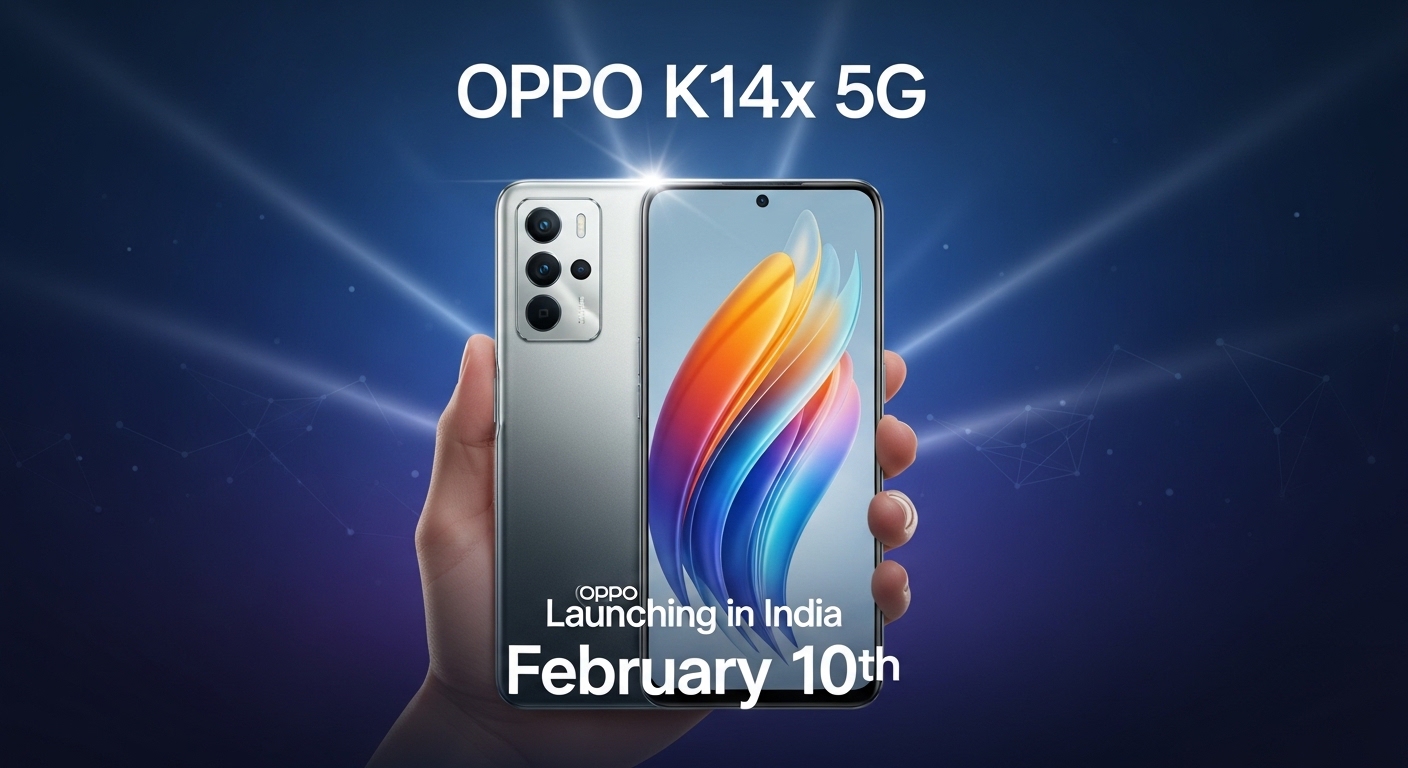
OPPO is jumping into the budget 5G smartphone fray with the K14x 5G, set to launch in India on February 10th. If you’re tracking Indian smartphone launches, you’ve probably noticed February is turning into an absolute battleground—Samsung just dropped the F70e on the 9th, and now OPPO is coming in hot the very next day. This isn’t coincidence; it’s strategic warfare for your wallet.
The K-series has been OPPO’s budget warrior lineup in India, focusing on delivering essential features at accessible prices without the premium bells and whistles of their Reno or Find series. The K14x looks like it’s continuing that tradition, but OPPO seems to be pushing harder on specs this time around to compete with the flood of budget 5G phones saturating the market.
OPPO’s K-Series: Understanding the Positioning
Before we dive into what the K14x brings to the table, let’s talk about where it fits in OPPO’s confusing lineup. The K-series sits firmly in budget territory, typically priced between ₹12,000 and ₹20,000. These phones prioritize battery life, decent displays, and adequate performance for everyday users who aren’t chasing flagship experiences.
Previous K-series phones like the K10 and K12 found moderate success by offering solid build quality and OPPO’s ColorOS experience at competitive prices. They weren’t chart-toppers, but they carved out a space for buyers who wanted something more polished than ultra-budget brands but couldn’t stretch to mid-range pricing.
The “x” designation in K14x suggests this might be a more affordable variant within the K14 family, possibly with some compromises to hit an aggressive price point. OPPO’s been known to launch multiple variants of the same phone with slight spec differences—it’s confusing for consumers but lets them cover more price segments.
Expected Specifications: What We Know So Far
OPPO has been teasing the K14x on social media and through retail partners, and leaks from reliable sources give us a pretty clear picture of what’s coming:
Display: The K14x will likely sport a 6.67-inch IPS LCD display with FHD+ resolution and a 120Hz refresh rate. OPPO has been good about including high refresh rate displays even on budget phones, recognizing that smooth scrolling is something buyers notice immediately in stores. The LCD panel means it won’t have the deep blacks and vibrant colors of AMOLED, but at this price point, a 120Hz LCD is respectable.
Peak brightness is rumored around 600-650 nits, which should handle outdoor visibility reasonably well, though not as impressively as flagship displays pushing 1,500+ nits.
Processor: Expectations point toward the MediaTek Dimensity 6300 or possibly the Snapdragon 4 Gen 2. Both are entry-level 5G chipsets built on efficient processes that balance performance with battery life. You’re not getting flagship power here—these chips handle daily tasks smoothly but will struggle with heavy gaming at maximum settings.
The Dimensity 6300 would be the more interesting choice, as MediaTek has been delivering impressive performance-per-rupee lately. Their chips often outperform equivalent Snapdragon models in benchmark tests, though real-world performance can vary.
RAM and Storage: Likely configurations include 6GB/128GB and 8GB/128GB, with possible 8GB/256GB option. OPPO will almost certainly include RAM expansion technology that uses storage as virtual RAM—they usually add 8GB virtual RAM on top of physical RAM. Whether this actually improves performance noticeably is debatable, but it looks good on spec sheets.
Storage expansion via microSD card should be supported, which is essential for budget buyers who store lots of photos, videos, and downloads locally.
Battery: This is where the K14x should shine. Rumors suggest a massive 6,000 mAh battery, possibly even the 6,100 mAh cell OPPO has used in other recent budget phones. That’s genuinely impressive capacity that should deliver two full days of moderate use without charging.
Charging speed will likely be 45W or 67W SuperVOOC fast charging. OPPO has been aggressive with fast charging even on budget phones—it’s one of their signature features. If they include 67W charging, you’re looking at 0-50% in about 20-25 minutes, which blows away most competitors in this price range still stuck at 25W or 33W.
Cameras: Expect a dual or triple camera setup with a 50MP main sensor, likely using Samsung’s ISOCELL JN1 or a similar sensor popular in budget phones. Secondary cameras will probably be a 2MP depth sensor and possibly a 2MP macro camera—neither particularly useful, but they pad the spec sheet.
The main camera should deliver decent photos in good lighting with adequate low-light performance thanks to software processing. OPPO’s camera algorithms have improved over the years, so expect usable results for social media and everyday photography.
Front camera will be a 16MP shooter in a centered punch-hole or waterdrop notch. Good enough for selfies and video calls, nothing groundbreaking.
Software: Android 14 with ColorOS 14 on top. ColorOS has evolved significantly—it used to be heavily criticized for being a blatant iOS copy, but recent versions have developed their own identity with useful features and cleaner design. OPPO typically commits to two years of OS updates and three years of security patches for budget phones, which is decent but trails Samsung’s four-year commitment.
Build and Design: Plastic back and frame are guaranteed at this price point, but OPPO usually does a good job making plastic feel premium through texture and finish. The phone will probably feature a gradient color design—OPPO loves their eye-catching gradients that look great in marketing photos.
Expect the phone to weigh around 195-205 grams. Not particularly light, but the weight distribution should make it comfortable for extended use.
Pricing Predictions: The Make-or-Break Factor
Here’s where things get crucial. The K14x needs to be priced aggressively to stand out in the crowded budget 5G segment. Based on OPPO’s recent launches and competitive positioning, I’m expecting the K14x to launch between ₹14,999 and ₹17,999 for the base variant.
At ₹14,999-₹15,999, it would compete directly with:
- Realme Narzo 70x 5G (₹14,999)
- Redmi 13 5G (₹14,999)
- Moto G64 5G (₹15,999)
- Samsung Galaxy F15 5G (₹15,999)
At ₹17,999-₹18,999, it moves into tougher territory with better-specced phones like the POCO M6 Pro 5G and Realme 12 5G competing for the same buyers.
OPPO’s challenge is that Chinese competitors like Realme (ironically, also owned by BBK Electronics like OPPO) and Redmi are typically more aggressive with pricing. OPPO positions itself as slightly more premium than these brands, which means they often can’t match them rupee-for-rupee on specs.
Launch Strategy: Online vs. Offline Play
OPPO’s strength has traditionally been their massive offline retail presence. Walk into any mobile store in India, even in smaller towns, and you’ll see OPPO phones prominently displayed. Their offline distribution network is second only to Samsung’s.
The K14x launch on February 10th will likely be a dual approach—online availability through Amazon India (OPPO’s preferred e-commerce partner) alongside retail availability in stores. This gives OPPO an advantage over online-only brands; buyers can actually hold and test the phone before purchasing.
Launch day offers will probably include:
- Bank discounts: ₹1,000-₹1,500 off with select credit/debit cards
- Exchange bonuses: Additional value for trading in old phones
- No-cost EMI: Making the phone affordable in monthly installments
- Bundled accessories: Possibly discounted OPPO Enco earbuds or cases
OPPO’s retail staff training is excellent—they know how to demo phones effectively and close sales. In offline stores, the K14x will be positioned against similarly priced Samsung and Xiaomi phones, and OPPO’s staff will emphasize fast charging and battery life as key differentiators.
The Competition: A Brutal Landscape
The budget 5G segment in India is absolutely savage right now. Everyone’s fighting for the same price-conscious buyers, and differentiation is increasingly difficult when most phones use similar components and offer comparable features.
Realme Narzo 70x 5G: Dimensity 6100+ processor, 120Hz display, 50MP camera, 5,000 mAh battery with 45W charging. Priced at ₹14,999, it’s a direct competitor with similar specs.
Redmi 13 5G: Snapdragon 4 Gen 2, 108MP camera (though the sensor quality is debatable), 5,030 mAh battery, MIUI’s feature-rich interface. Xiaomi’s brand strength and massive community support make this a tough competitor.
Samsung Galaxy F15 5G: Dimensity 6100+, Super AMOLED display (a significant advantage), 6,000 mAh battery, Samsung’s brand trust and service network. Priced around ₹15,999, it offers premium display tech that’s hard to beat.
Moto G64 5G: Dimensity 7025, clean Android experience close to stock, 50MP OIS camera (image stabilization is rare at this price), 6,000 mAh battery with 33W charging.
POCO M6 Pro 5G: Snapdragon 4 Gen 2, 120Hz AMOLED display, 5,000 mAh battery with 67W charging. POCO’s aggressive pricing and gaming-focused marketing appeal to younger buyers.
What can the K14x do differently? OPPO’s likely betting on:
- Faster charging: If they include 67W SuperVOOC, that’s a tangible advantage most competitors can’t match
- Premium design: OPPO’s industrial design is typically more polished than competitors
- Offline availability: Being able to buy and service the phone at local stores matters for many buyers
- ColorOS features: While divisive, ColorOS has loyal fans who appreciate its customization options
OPPO’s Challenges in India’s Market
Let’s be real—OPPO has been struggling in India lately. According to Counterpoint Research (https://www.counterpointresearch.com), OPPO’s market share in India has declined over the past year. Several factors contribute to this:
Pricing perception: OPPO is often seen as overpriced compared to Realme or Xiaomi offering similar specs for less money. The brand premium OPPO commands in offline stores doesn’t always translate online where buyers can easily compare specifications.
Chinese brand sentiment: Anti-China sentiment occasionally flares up in India, affecting all Chinese brands including OPPO. While not a constant factor, it creates headwinds for market growth.
Xiaomi’s dominance: Redmi phones utterly dominate India’s budget segment with incredible brand loyalty and a massive user community. Displacing Xiaomi is extraordinarily difficult.
Realme’s aggression: Realme, despite being OPPO’s sibling brand under BBK Electronics, directly competes and often offers better value propositions. The internal competition sometimes seems to cannibalize OPPO’s potential sales.
Software concerns: ColorOS, while improved, still faces criticism for pre-installed apps, aggressive notifications, and bloatware. MIUI has similar issues but stronger brand loyalty to offset them.
Who Should Consider the K14x?
The OPPO K14x 5G will appeal to specific buyer segments:
Offline buyers who want to touch and feel phones before purchasing. OPPO’s retail presence means you can actually hold the K14x, test the camera, and make an informed decision rather than buying blindly online.
Users prioritizing fast charging. If OPPO includes 67W SuperVOOC charging, that’s a killer feature for people who hate waiting hours for their phone to charge. Quick top-ups during lunch breaks or commutes become possible.
ColorOS fans. If you’ve used OPPO phones before and like ColorOS’s interface, features, and customization options, sticking with the ecosystem makes sense.
Budget buyers wanting decent cameras. OPPO’s camera processing is generally good, and the K14x should deliver satisfying results for Instagram, Facebook, and everyday photography.
People valuing design aesthetics. OPPO phones typically look and feel more premium than their price suggests, which matters to buyers who care about aesthetics.
What Could Go Wrong?
Several factors could derail the K14x launch:
Aggressive pricing from competitors: If Realme or Xiaomi drop prices or launch competing models on February 10th, OPPO could get overshadowed immediately.
Disappointing performance: If the processor can’t handle everyday tasks smoothly or overheats during use, reviews will be harsh and word-of-mouth negative.
Poor camera results: The 50MP main camera needs to deliver in real-world conditions. If photos are mediocre, that’s a deal-breaker for many buyers.
Software bloat: Too much pre-installed bloatware, aggressive ads, or notification spam would hurt the user experience and drive negative reviews.
Service issues: If OPPO’s service network can’t handle the volume of devices or provides poor customer service, that damages brand reputation.
Launch Day Buying Advice
Should you buy the K14x on launch day? My recommendation: probably wait.
Here’s why:
Reviews take time: Tech reviewers need at least a week to properly test battery life, camera performance, gaming, and real-world usage. Launch day purchases are essentially blind buying based on specs alone.
Prices often drop: Smartphone prices in India rarely go up—they almost always drop within weeks. Unless launch offers are extraordinary, waiting saves money.
Stock issues: First production batches sometimes have quality control problems. Waiting for the second or third batch reduces chances of getting a defective unit.
Competition responds: Other brands might launch counter-offers or promotions. Giving the market a few weeks to settle shows you all available options.
That said, if you’re an existing OPPO user happy with ColorOS, and the K14x launch price with offers comes under ₹14,000, it might be worth grabbing. Just make sure you’re buying from a source with a good return policy in case it doesn’t meet expectations.
The Bigger Picture: OPPO’s Survival Strategy
The K14x launch on February 10th is part of OPPO’s broader fight to remain relevant in India’s smartphone market. They can’t compete on price alone against Xiaomi and Realme, so they’re betting on:
- Superior offline experience: Retail presence and knowledgeable staff
- Faster charging: A tangible feature customers notice daily
- Design polish: Making phones that look and feel premium
- Camera capabilities: Leveraging their imaging expertise from premium phones
Whether this strategy works depends on execution. OPPO needs the K14x to be genuinely good, not just acceptable. In a market where buyers have endless options and zero brand loyalty, every phone launch is a referendum on whether the brand deserves to survive.
February 10th will show us if OPPO still has what it takes to compete in India’s brutal budget smartphone arena. My advice? Watch closely, wait for reviews, and don’t let launch day hype cloud your judgment. Your money deserves better than impulse purchases.